Individuals with serious illness, and their caregivers, are proving an enticing target for fraud networks using promises of cures as lures. The scammers post on social media offers to access “medbeds,” a nonexistent technology without medical basis, touting it as having “miracle” abilities to heal an array of ailments.
We observed social media accounts encouraging individuals to pay for alleged access to medbeds, capitalizing on vulnerability to turn a profit. Graphika is tracking the networks involved in these scams, documenting their tactics, and analyzing their behavioral footprint.
Key Takeaways:
-
Cross-platform presence: We identified "medbed" activity across Facebook, TikTok, YouTube, Instagram, and X.
-
Coordinated tactics: Fraud networks use a uniform sequence to move targets from public platforms to private, off-platform channels.
-
Impersonation: Scammers often use the likenesses of well-known influencers to deceive people into trusting fraudulent schemes..
-
Behavioral signposts: These assets often have limited lifecycles, appearing and disappearing to evade platform moderation.
The Medbed Scam Lifecycle
This widespread hoax is unfolding across Facebook, Instagram, TikTok, and YouTube. The details vary across platforms, but each instance largely follows a uniform sequence:
- Promotion: Scammers share content promoting medbeds as a miracle cure and advertise free access to the treatment.
- Engagement: After an interested party interacts, the scammers direct them to make contact off-platform, such as by email or Telegram. (Mention of payment is still typically absent at this point, not mentioned in public-facing posts or comments.)
- Monetization: Once in a private channel, the scammers explain there is a registration fee or other cost. They prompt their target to provide credit card details or submit payments via services such as PayPal, Zelle, CashApp, Venmo, or MoneyGram.
- Abandonment: Following the payment, the scammer abandons contact and the target is left without service or explanation.
These accounts and groups seem to have a limited lifecycle. They often pop up, disappear, and are replaced by new assets. It might because of content moderation, or because scammers delete old pages that have already netted victims.
Impersonating Influencers to Build Trust
The scammers adopt a range of personas to execute this scheme. We observed many accounts using the name and likeness of popular medbed influencer Kerrie-Anne Thornton, better known as Skye Prince. Thornton denies a connection to those accounts but claims to have “received the necessary training” to operate a medbed.
On Facebook, we identified approximately 100 groups, 60 accounts, and 10 pages using variations of “medbed” and “Skye Prince” in their names. Some groups have tens of thousands of followers. Even more groups and pages reference Skye Prince or medbeds in their names and content.
The Facebook group/page administrators post content praising medbeds, claiming they can cure any illness and regrow limbs, that the government or other “evil” forces have suppressed the technology, and that the technology’s unveiling is imminent. They share images of the supposed technology, and often reply to commenters to reassert the treatment’s efficacy.

A comment on a Facebook post by a medbed-focused account, followed by the account operator’s claim that a medbed will reverse stroke damage.
On Facebook the scammers encourage interested users to pay to secure their “appointment” to use a medbed. They present a long list of email addresses to choose from, categorized by country, or invite users to use Telegram or Google Forms. They also direct individuals to message Telegram accounts or view Telegram channels to learn more about medbeds.

A Facebook comment response from a medbed account operator justifying the “registration” fee.
On TikTok, scammers make use of the messaging feature to direct users to email or Telegram accounts. Using an open-source tool, we identified several of these accounts as operating from Nigeria.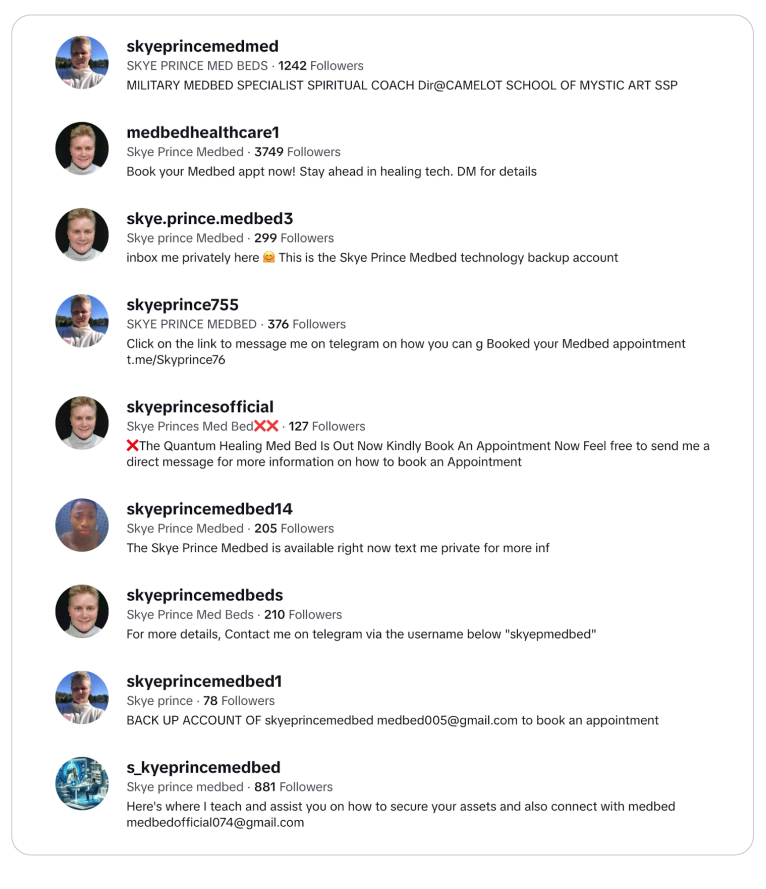
Some of the more than 60 TikTok accounts claiming to be associated with “Skye Prince” and “medbeds.”
On YouTube, “Skye Prince” channels direct users to schedule appointments via email or Telegram, listing contact details in video names, channel descriptions, and video descriptions.

YouTube video claiming medbeds are now available and directing users to email for an appointment.

Instagram post explaining the long list of ailments medbeds can supposedly treat, and encouraging users to email for an appointment.
On X, “Skye Prince” accounts mainly direct users to message them on-platform, but at least one shared Telegram links and an email address.

X account encouraging users to reach out via email or Telegram to book their medbed appointment.
Increasing Scam Risk for Online Users
Global scam operations are growing at a rapid clip. Fraudsters frequently experiment with new methodologies and iterate on previous attempts to lure victims. The medbeds scam demonstrates social engineering, in which malicious actors select a vulnerable target and coax them into a compromising situation; certain populations, like the sick or elderly, may face particular risk of exploitation, but no online user is truly immune.
Graphika tracks scam activity across social media platforms and identifies behavioral patterns in real time. To learn how our tools and analysts can help protect your team, book a demo.